
However, as recent research from MIT highlights, the truth is complex: while AI optimizes energy grids and improves manufacturing, its full environmental impact remains unclear. Data centers powering these systems consume massive resources, creating a delicate balance between progress and responsibility.
AI and Sustainability: A Transformative Partnership
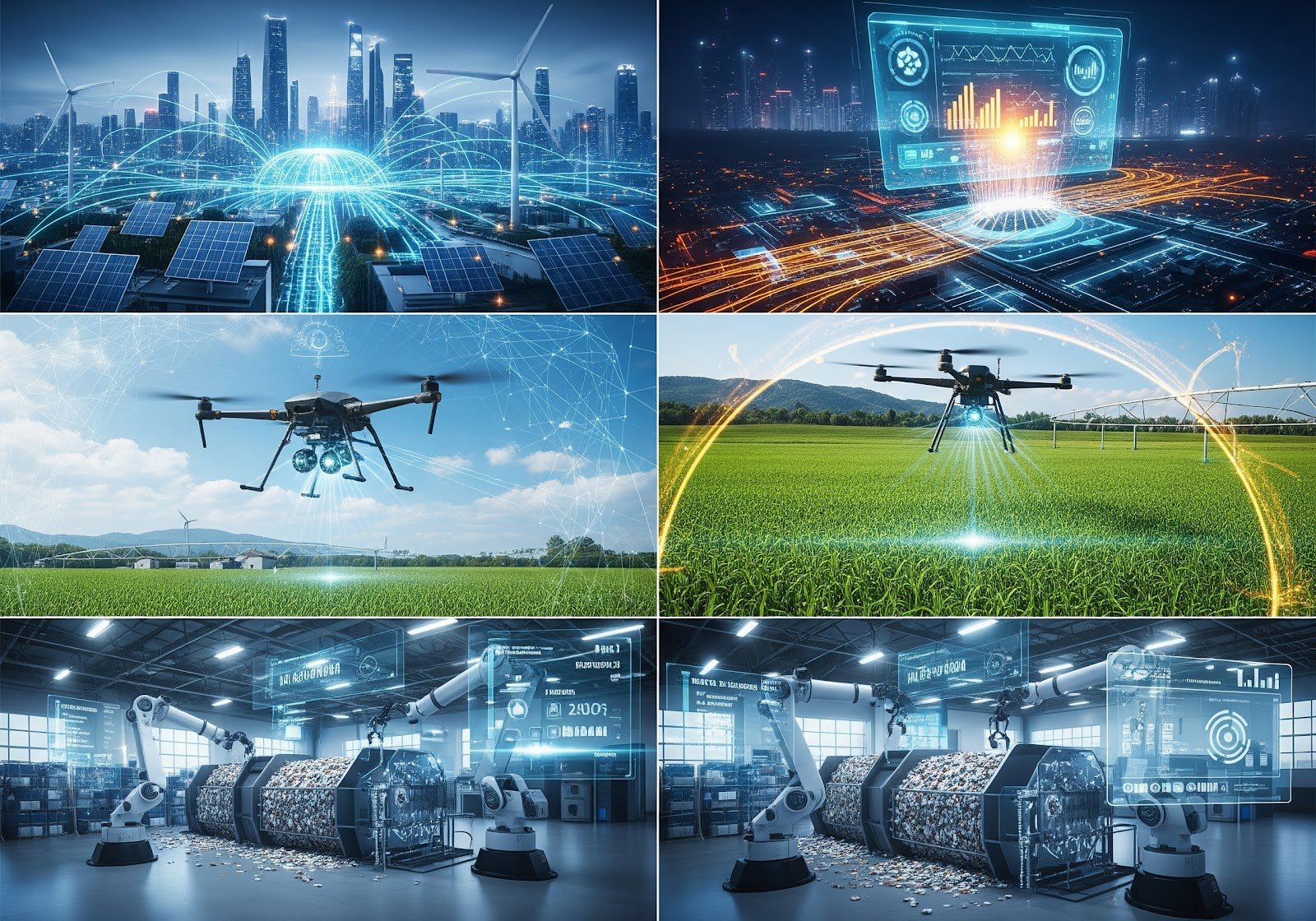
Modern infrastructure thrives when paired with smart systems. AI tools analyze vast environmental data faster than humans ever could. Penn researchers have found that AI optimizes energy grids, smoothing the shift to renewables like solar and wind. Real-world applications are already impactful: utilities use predictive algorithms to balance supply and demand, farmers rely on smart irrigation to conserve water, and material science benefits from pattern recognition for decarbonization.
Extreme weather preparation is another significant win. Machine learning spots climate trends early, helping society prepare for storms or droughts. This “climate intelligence” could save lives and resources. In industry, these tools dramatically cut waste; factories reduce energy use by 20% with real-time monitoring, and logistics networks slash emissions by optimizing routes. The potential for positive impact grows as technology evolves.
The Environmental Cost of AI: Energy and Resource Demands
Behind every smart algorithm lies a hidden environmental price tag. While AI tools optimize industries, their creation strains natural resources. The carbon footprint of training models can even rival traditional sectors like aviation.
Data Centers: The Power-Hungry Backbone
Server farms guzzle electricity to process complex computations. A single data center can consume as much power as 50,000 homes. Cooling these systems adds another layer of demand, often requiring millions of gallons of water annually. For instance, a 2021 MIT/Berkeley study found that “Training GPT-3 emitted 552 tons of CO₂ – equivalent to 300 round-trip flights from NYC to London.” Liquid cooling systems, while preventing servers from overheating, drain local water supplies, particularly in drought-prone regions.
Carbon Footprint of Training Generative Models
Larger models with billions of parameters need weeks of computation, and each retraining cycle repeats this energy-intensive process. While renewable-powered data centers cut emissions, fossil fuels still dominate globally. Text generation generally costs less energy than image creation—up to 30% lower. Furthermore, hardware production adds embodied carbon, often ignored in assessments, and shorter obsolescence cycles mean frequent retraining, multiplying environmental impacts.
AI’s Positive Impact: Solving Sustainability Challenges
Despite its challenges, AI is a powerful force for good in sustainability. Walmart, for example, has slashed emissions by 15%, demonstrating a growing trend across industries where smart tools transform how companies tackle resource waste and inefficiency.
- Optimizing Energy Grids: Power grids now adapt in real time, with algorithms balancing renewable energy sources like wind and solar, reducing reliance on fossil fuels. In Texas, smart systems have prevented blackouts during peak demand, saving millions in potential losses.
- Climate Modeling and Disaster Prediction: Machine learning spots hurricanes weeks earlier, enabling farmers to protect crops and cities to prepare evacuation routes. Google’s flood alerts now cover 80 countries, showcasing technology’s lifesaving potential.
- Reducing Waste in Manufacturing and Logistics: Siemens cut steel production waste by 20% using predictive maintenance. Similar gains ripple through supply chains: Walmart’s AI-routed trucks drive fewer miles, trimming fuel use, and food distributors like Kroger reduce spoilage with smart inventory systems. Maersk’s ships save 22% fuel by optimizing ocean routes. The International Transport Forum (2023) notes that “Every 1% efficiency gain in global logistics equals 30 million tons of CO₂ avoided annually.”
Circular economies also benefit from material tracking, ensuring metals and plastics are reused, not landfilled, leading to leaner operations and a healthier planet.
Generative AI’s Double-Edged Sword
Every ChatGPT query burns energy equivalent to multiple web searches. While these models boost productivity, their hidden costs spark debate, with a single request demanding 7-10 times more power than traditional searches. Text generation is efficient compared to multimedia, but creating images or videos drains far more resources—up to 30% higher. The trend toward larger models, like GPT-4, amplifies this gap. Continuous fine-tuning adds layers of energy use, as each update retrains systems, repeating carbon-intensive computations. While NVIDIA’s H100 GPU offers hope by cutting power demands by 25%, the Stanford HAI Report (2024) reminds us that “Scaling generative tools requires balancing innovation with planetary limits.” The path forward demands smarter design, with smaller, specialized models potentially reducing footprints without sacrificing utility.
Renewable Energy and AI: A Path to Carbon Neutrality?
Harnessing the full potential of solar and wind energy requires smart solutions due to their fluctuating supply. AI steps in to balance grids and store excess power.
Solar and Wind Energy Management
Smart algorithms predict weather patterns to optimize renewable output. Google’s AI forecasts wind power 36 hours ahead, boosting efficiency by 20%. Load-shifting tools reroute excess energy to high-demand periods.
The Role of Battery Storage
Degradation prediction models extend lithium-ion lifespan by 30%. Tesla’s Autobidder platform automates grid storage, trading power during peak rates. MIT researchers, as highlighted by the MIT Energy Initiative (2024), have shown that “Machine learning cuts battery development time from decades to months.”
The race for carbon neutrality hinges on smarter storage, with every innovation bringing renewables closer to replacing fossil fuels for good.
Sustainable AI Development: Strategies and Innovations
The semiconductor industry is pushing boundaries with eco-conscious chips. Google’s TPU v4, for example, delivers twice the efficiency of its predecessor while maintaining peak performance, demonstrating how smarter hardware can reduce environmental impacts.
Edge Computing as a Low-Energy Alternative
Local data processing dramatically slashes energy needs. Instead of routing requests to distant servers, edge devices handle tasks nearby. Smart sensors in agriculture exemplify this by analyzing soil moisture on-site rather than transmitting raw data. Neuromorphic architectures, mimicking human brain efficiency, process information in parallel, cutting power demands by 40%. Intel’s Loihi 2 chip achieves 10x better performance per watt.
Efficient Hardware Design
Photonic processing chips use light instead of electricity. Lightmatter’s Envise system outperforms GPUs while consuming 90% less energy, a technology that could revolutionize data centers within five years. According to the MIT Semiconductor Review (2024), “TSMC’s 3nm process reduces power leakage by 35%, setting new benchmarks for sustainable fabrication.” Cerebras’ wafer-scale engine consolidates compute power, replacing thousands of smaller chips and trimming cooling costs and material waste.

Policy and Regulation: Guiding Responsible AI Use
Governments worldwide are stepping up to shape responsible tech practices, with policy tools like tax breaks and transparency rules steering innovation toward lower environmental impacts. The EU and US are leading with bold frameworks that reward efficiency.
Corporate Sustainability Reporting Mandates
The EU’s Corporate Sustainability Reporting Directive (CSRD) sets strict disclosure rules, requiring companies to track and publish energy use, supply chain impacts, and improvement plans, driving accountability across industries.
US Incentives Accelerate Progress
The Inflation Reduction Act earmarks $7 billion for clean tech integration, including data center tax credits and NSF grants for efficient computing research. Singapore’s AI Sustainability Certification offers a global model, with over 120 firms participating.
Carbon credit systems, with companies like Microsoft buying offsets for its Azure cloud platform, complement regulatory pushes, creating a multi-tool policy ecosystem.
Ethical Considerations: Bias and Environmental Justice
Tech solutions often overlook who bears the heaviest burdens. Research shows data centers frequently locate in low-income areas, where water shortages hit hardest. MIT studies reveal these facilities consume millions of gallons annually, often in drought-prone regions. Training data can carry its own biases, with climate models sometimes excluding vulnerable communities, creating blind spots in disaster predictions and leaving marginalized groups at greater risk. Algorithmic redlining can worsen this impact, as seen in the Flint water crisis. Some teams now integrate indigenous knowledge into weather models, combining traditional wisdom with modern tools to improve accuracy for rural communities. The UN’s ethics guidelines encourage such inclusive practices. As the MIT Environmental Solutions Initiative (2023) states, “Environmental justice means asking who benefits—and who pays—for technological progress.”
The Future of AI: Balancing Growth and Sustainability
Next-generation solutions blend nature’s wisdom with digital precision. Researchers worldwide are reimagining how systems operate, from microscopic sensors to continent-spanning power grids. This evolution demands careful calibration between technological progress and ecological responsibility.
Energy Forecasts and Efficient Breakthroughs
MIT’s analog chips mark a turning point, using just 1% of traditional power. These neuromorphic designs process information like human neurons, slashing energy needs and handling complex climate modeling with unprecedented efficiency. IBM’s nuclear reactor optimization project demonstrates how machine learning can streamline clean energy production, reducing waste by 17%.
Nature-Inspired Innovations
Biodegradable sensors now monitor soil health across farmlands, transmitting data for months before decomposing harmlessly. Algae cooling, biomimicry chips, and blockchain tracking for renewable energy certificates are all examples of nature-inspired innovations. The MIT Microsystems Laboratory (2024) predicts that “Analog computing could reduce global data center emissions by 40% within this decade.”
The path forward requires hybrid thinking, combining biological principles with digital intelligence to find smarter ways to grow responsibly, creating systems that benefit both people and the planet.
Conclusion
Progress demands both innovation and accountability, especially for our planet. AI and sustainability efforts reveal tough tradeoffs: energy use, water scarcity, and carbon footprints. MIT’s lifecycle frameworks help measure these impacts. Policy-technology collaboration is key, with governments incentivizing green development and companies adopting transparent benchmarks. Individuals also play a role, as choosing efficient tools pressures corporations to improve. The economic upside is clear, with renewable-powered data centers and edge computing unlocking new markets. Startups like Lightmatter prove eco-friendly tech can outperform traditional systems. Looking ahead, the future hinges on balance. With smart policies and responsible choices, we can harness innovation without sacrificing our planet. The solutions exist—now we must scale them.